
Guide · 8 min read
Are indoor golf simulators accurate?
Short answer: the good ones are extremely accurate — accurate enough that PGA tour pros use them to fit clubs and dial in launch conditions. The bad ones are not. The variable is the launch monitor, not the screen. This guide explains the difference between photometric and radar systems, and why it matters for the numbers you see at the end of a swing.
Indoor golf has a reputation problem. Most people's first experience with a simulator is a bar or a basement running a five-year-old radar unit pointed at a tarp — and the numbers feel like a video game, because functionally, they are.
That's not what serious indoor golf is. A tour-grade launch monitor — overhead, photometric, high-speed — produces data that's good enough to fit clubs, build a swing, and trust on the course. The same hardware that runs in PGA tour vans is what runs at a properly built indoor facility. The difference between "fun arcade" and "real practice" comes down almost entirely to which sensor is in the room.
How they work
Two ways to measure a golf ball indoors.
Photometric
High-speed cameras, measured directly.
Photometric launch monitors photograph the ball and the club face at the exact moment of impact, then compute ball flight from physical evidence: ball speed, launch angle, side angle, spin rate, spin axis, club head speed, angle of attack, club path, impact location, smash factor. Because the data is captured at the source, the system doesn't need ball flight to make a measurement. Indoor or outdoor, the answer is the same.
Examples: Foresight GCQuad, Foresight Falcon, Uneekor EYE XO, Full Swing KIT (camera).
Radar (Doppler)
Tracks the ball, infers the rest.
Radar launch monitors emit a Doppler signal and track the ball after it leaves the face. Outdoors, they have hundreds of feet of flight to observe and produce excellent data. Indoors, the ball hits the screen in roughly six to ten feet — so spin and club delivery are inferred from a very short window of flight. The hardware is excellent; the indoor environment just doesn't give it much to work with.
Examples: TrackMan, FlightScope, Garmin R10.
Side by side
What the numbers come from.
Outdoors, radar is excellent and frequently the best choice. The conversation changes indoors, where short ball flight limits what radar can observe directly.
Case study
The Foresight Falcon, specifically.
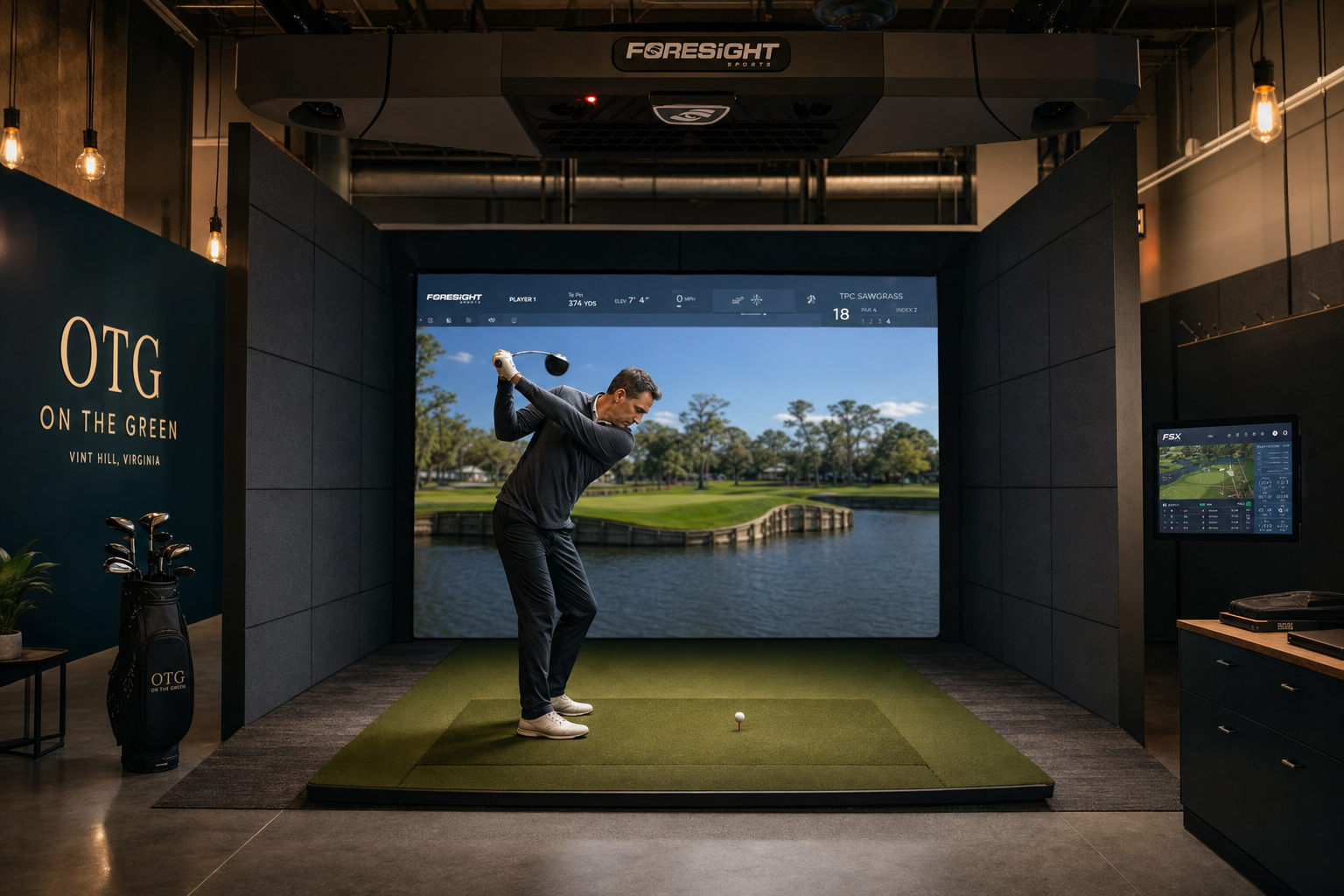
The Falcon is the overhead version of Foresight's Quadrascopic camera platform — the same imaging engine used in the GCQuad, which sits in PGA, LPGA, and Champions tour vans and in nearly every serious club-fitting studio in the country. Four high-speed cameras in the ceiling capture more than a dozen ball and club data parameters per shot, measured directly from imagery at impact.
Practically, that means the numbers you see at the end of a swing are the numbers you actually produced. Not a model. Not a Doppler estimate compressed into a six-foot flight window. The image at impact is the evidence. Foresight publishes ball-data accuracy within roughly 1 mph of ball speed and under a degree on launch and spin axis, with club delivery captured directly from the impact frame.
Mounting overhead also solves two ergonomic problems floor units can't. There's nothing next to the ball to aim at or look down at, and the 59-inch by 28-inch hitting zone lets left- and right-handed players share a bay with no recalibration.
Before you book
Four questions worth asking any indoor bay.
01
Is it photometric or radar?
Indoors, photometric capture has a structural advantage. Radar units are excellent — outdoors. If a bay won't tell you what's in the ceiling, that's the answer.
02
Where is the sensor mounted?
Overhead beats floor for almost every reason that matters: no alignment ritual, no obstruction next to the ball, no recalibration when handedness changes.
03
What data parameters are measured vs calculated?
Ball speed, spin rate, spin axis, club path, club face, and angle of attack should be measured directly. If any of those are 'modeled' or 'estimated', the system is making it up from less evidence.
04
Is it the same hardware fitters use?
The Foresight Quadrascopic platform (GCQuad / Falcon) is the most common answer in serious fitting studios. If the bay runs that hardware, the data is good enough to fit clubs on.
Common questions
Indoor accuracy, answered.
Are indoor golf simulators accurate?
What's the difference between photometric and radar launch monitors?
How accurate is the Foresight Falcon specifically?
Is indoor data good enough for a real club fitting?
Why is overhead mounting better than a floor unit?
Will my indoor numbers match what I see on the course?
See the data for yourself.
An hour on a Foresight Falcon is a better answer than any article. OTG runs four Falcon bays and a dedicated PuttView green in Vint Hill, Virginia.